Monday, August 17, 2015

Nothing but Batteries


We leave Long Point. The easy life of flat grassy campsites with electric hook up is over.  We’ve moved on to Keewaydin on the St Lawrence, a nice semi-shady place but in a camp ground with vehicles and people packed in like ferry cargo.  Actually, the only passenger-vehicle ferry making the international crossing is in Cape Vincent. When the 11 am ferry crossed from Wolfe Island, Canada one car and two bicyclist boarded.  How do they make money?  The thought of the ferry crossing from Maui to Molokai getting skunked by the airlines came to mind. Here the skunk is the 1000 Island International Bridge.   

Dad and I left the peninsula about 10am and puttered around the whole day.  A stop in Cape Vincent for a latte. A demonstration on how to use an ATM. We are now flush with a $100 cash. Money when we attempt to rent a boat. We strolled around the docks, looked at sail boats. Went to the DEC aquarium featuring Ontario’s lake fish from sturgeons to invasive gobis. Dad and I were impressed with the  display of crayfish claws. We even saw the notorious blue one that apparently are deposited by seagulls in the winter. At least that was Shangri-la Tom’s story.  I don’t know where seagulls get crayfish in the dead of winter.

Dad had nicked his finger restacking the firewood. I had not noticed until I watched him get blood all over the RV door. He brushed it off. Didn’t even want to wash the dried blood off his fingers. It was a seriously small nick, but blood was all over his fingers. I got a damp paper towel and had him clean his hand. Then I applied a bit of antibiotic. He refused a Band-aid. Mentioned his blood thinner.

We hit Clayton and the Antique Boat Museum about 1pm, in time to tour the La Duchesse, a huge barge-like houseboat that had a very sketchy record as boats go. It sank twice, the second time within hours of being raised the first time. And the thing doesn’t even have a motor, but like every ostentatious   boat a dance floor, a Steinway and enough claw-foot bathtubs to embarrass a brothel.  

We had an opportunity to get out in a skiff. Dad had no difficulty getting into the boat from the dock, but it got a little dicey when he wanted to row.  He came from the bow to the mid-section.” Stay low Dad.”  There were no sea rescues. I counter balanced any of Dad’s suspect maneuvers. I’m sure the staff (college kids) had a good laugh.  This rowing experience reminded of the time when a certain sea captain was so sure I didn’t know how to row a boat.  Pretty insulted I got in, purposely sat facing the wrong way and flapped the oar around sending the boat in a tight circle. The look on his face still makes me laugh.

By 4 pm we shoved off to the campground. The Park Ranger was a young college student named Kaylin. Today was her last day at work, returning back to school next week. Fredonia, where my sister had gone.  She asked Dad if he had been in World War II and she shook his hand. I thought the two were going to arm wrestle. Dad has a strong grip. Apparently, she does too.

There was a billing glitch. Apparently we owed $45.00.  Everything had been paid on-line when the reservations were made back in June.  She said she’d figure it out and sent us on our way.  After we got the RV leveled, (and I thought I would have nightmares all night long fretting that we would roll off the hill into the river.) she came to our site and explained she worked everything out.  She told us she was a history major and was interested in talking to Dad some more. That explained why she was curious about Dad’s service.  Not too many kids acknowledge that there aren’t too many WWII veterans left.  It is a rare a 20-something kid would care.  She asked if she could come by tomorrow in the early evening. 

Dad tried to start a fire but all we had was newspaper and logs.  He was successful in filling the RV with smoke. Without power we turned in early relying on candle light and flashlights isn’t fun. I’ve a fully charged computer battery and 70% on my phone. My data plan turned over last night so I’m one gig full.


Saturday, August 15, 2015

Small Stuff

I kept suggesting to Dad things to do today. Since he is a history buff I suggested a military museum at Sacket Harbor. No bites. The weather was overcast and although the forecast said little chance of a thunderstorms it sure as hell looked like rain would break out any second. It never materialized and ten minutes to noon Dad suggested we rent a boat.  I was sort of game despite the wind, there are parts of Chaumont Bay that are sheltered.  The state wanted $50 for the boat, $10 for gas and of course tax. Credit cards work, but they also wanted a $100 in cash as a deposit. Between the two of us we had $80.  Since we are so far from anywhere there might be a bank, much less an ATM, we nixed the plan, had a sandwich and took a little stroll to the end of the point where the park sits.

Dad’s been amazed about all the flat rocks. This brought up a little geology. I suspected sedimentary under glacial pressure and ta-da, I was sort of right when I Googled it. But I also learned that Ontario once flowed out toward Syracuse down the Mohawk, Hudson and to the Atlantic. It was also once part of the Atlantic. After the 6500 foot thick glaciers thawed and reopened the St Lawrence the lake emptied out where we know it today. All this from memory so if you want to challenge it, look it up.

I suggested we flush out the water tank in the RV. It was mid-afternoon when we finished. Instead of returning to our site I thought we should explore the peninsula.  What a discovery found at the end of the spit. The village of Peninsula Point.  Full-time residents I’m guessing ten. Summer residents, not too many more. Town has three buildings- the store, the restaurant and the church.  So many buildings on this one lane road I kind of got lost in quaintness. Heck the restaurant’s named Shangri-la.  

Dad and I entered the old store, a clapboard building with wooden floors. Unpainted, weather gray, it sat squeezed between the narrow road and the bay. Behind the store were the remains of a boat dock destroyed by the lake’s thick ice. Government designed, government built and according to two of the ten residents the government is supposed to rebuild it this fall. It’s jumbled concrete slabs that look like got struck by an earthquake hit.

Tom, who was hired yesterday and started today, greeted us like old lost friends. He sat at a large round table at the front of the store reading a newspaper. I told him I was lost. Looking for ice cream actually. “Well, we don’t have any, but across the way they might. I’ve seen sprinkles in there. That’s a good sign of ice cream.”  Tom was so friendly he even showed us where they put his pace maker in. Well, maybe that was too much too soon. 

The restaurant was a revamped bar, restaurant, pool and game room, and headquarters for the campground up the hill.  Ice cream consisted of a rather large choice of ice cream bars. I selected a peanut butter crunch and Dad had the same. We sat at a booth, listening to a ball game and reading the menu.  Dad asked if I wanted a drink and I suggested we get it from the store.  We strolled back across the street.
Three teenage boys were now hanging out with Tom. Topic: fishing. Perch which can go for $15 a pound. Tom pays his bills and keeps out of trouble by fishing. I wondered how much trouble a man with a pace maker can get into. There was a warm sweet smell in the air. The boys and Tom had a loaf of fresh baked coconut bread. He invited us to have some.  A special delivery from another resident named Ruth. So there we sat in the old Gas, Beer, Ice, Food and Bait shop eating coconut bread, and sipping soda with three teenagers from Peninsula Point and Tom, a not-yet-so-middle- aged man who had spent his summers on the Point with his granddad. Feeling right at home, down home and lost in Shangri-La.

Saving Memories, Losing History

The last thing my mother taught me was how to light the oven in the RV.  I had loaded the rig with a couple hundred books and two cats. This was my maiden voyage in the Sun Raider. The self-promoting book tour for The Last Voyage of the Cosmic Muffin.  Mom’s health was failing during July and early August yet she insisted on showing me how to light the oven. She hardly had the energy or strength get into the camper. I kept saying she didn’t need to show me. But she insisted. She laid on the floor to point out where the pilot light was located. I don’t think I ever really saw it as I knelt beside her staring deep into the black reaches of the oven. I’m not even sure if she managed to ignite the pilot. The whole moment was a trial, but I do remember thinking that this would be the last time Mom would ever again be in the Sun Raider.  I didn’t know this to be the truth.  The next morning I drove away. The last time I saw my mother smiling and waving she sat in a lawn chair at the end of the driveway.  And I never once lit the stove until this year, nine years later.  This is a memory I shared with no one else.

Last night I warmed some Italian bread to go with our spaghetti dinner. Getting the pilot light lit was not a problem.  Lighting it was part of my all-systems-go check.  But keeping the fire burning in the oven was another story. It kept going out. And this morning when I tried to make toast the same thing happened. Dad thought it was the wind. It sure has been windy but seriously, not in the oven.  And although I got dinner made tonight – hobo stew – the flame kept puffing out.  Well, there is the microwave.  If Mom had trouble like this she would not have been cooking baked ziti, stuffed shells and other signature meals.  Dad doesn’t remember any problems with the stove, but then again he doesn’t remember the water leak either.
Where do these things go missing? Why do I store the small detail of Mom showing me how to light the oven?

Besides the oven, I’ve discovered other stuff that’s not right.   After fixing a nice mocha drink to take to watch the sun break out of the clouds, I found the drink with a foul taste.  The culprit, the water from the rigs tanks.  I’m so glad I’m not sailing in the middle of the ocean. The water is bad.  I ditched the drink and in Cape Vincent bought four gallons of water.  The tanks need to be flush and re-sanitized before we kill ourselves with cholera or some other third world disease.  
I try to keep Dad busy with useful chores. The cleaning the water system is a good one, but I’m not ready to do it. I need bleach and vinegar.  Maybe when we get to the next campground.  Meanwhile I assign tasks.  He hooked up the rig to the electrical outlet. Yeah that’s right. Plug it in. He tightened the nut on the side mirror which kept turning inward every time he closed the passenger down.  He attempted to fix a broken latch on the cover to the electrical panel. I had already figured out how I would fix it but had not done it when he started to fool with it. “Someone might accidentally hit one of these switches,’’ he said bent down to inspect the panel.  I wanted to say, “Like who, Dad? I’m not going to hit them. So it must be you.” Together we rigged a temporary latch, one made of a twist tie from the loaf of bread and an old diabetic stick pin found in the rigs utility junk box.

Despite the chores we managed to grind down the road to Cape Vincent to see the Tibbits Point and lighthouse at the end of the Great Lakes and the beginning of the St Lawrence Seaway.  It’s a short ferry ride to Wolfe Island, Canada, but couldn’t see any reason to do go.  So we went down to Brownville to see the Brown’s Museum. At least, that was what the road sign said. A few dusty display cases in the hallway outside the public library housed in the same building of several municipal offices. All this was located in the Brown Mansion, formerly the owner Jacob Brown. And who was Jacob Brown? He was a commanding general in the War of 1812 and won several major battles against those pesky British and Canadian invaders.  Of the nine major battles in this war, Brown won three.
Dad and I were reading a plaque near the street in front of the mansion when a gentleman walking his Scotty approached us. He told us more about the mansion than we had learned in the hallway including a story of when Governor Dewey had come to visit and the caretaker refused to admit him and his entourage. As a boy he use to play in the basement of the mansion. Its floor packed earth and the room filled with old cannon balls.  He claimed there are a lot of artifacts in the building, but lamented that few are interested in preserving this history.

Little bits of history, memories and stories are scattered everywhere in life.  Some get recorded and passed down through time. Some things are just ignored.  More things are forgotten than remembered. And over time, lost when the keepers of such history pass away. Someone like Jacob Brown, a farmer, a teacher, a surveyor, a builder and a solider…forgotten despite his contributions to this nation.  Some actions like those of my mother gone.
On the same day Mom taught me how to light the oven, she insisted I take the ice pick.

“Ice pick? It’s August. I’m not going to have much need for hacking ice.”
“Well, you use it to get the ice out of the metal ice tray.” The obvious struck me as silly.

“Mom, they make ice trays that flex and the ice pops out.” By why buy those when the RV came with small metal trays that hung onto the ice like winter hangs onto late March in upstate New York.
Now I have a couple of plastic trays in the freezer.  And I packed the ice pick too.  Just in case.

Thursday, August 13, 2015


Destination Long Point State Park, Chaumont Bay, NY.
In 1986 when Mom and Dad headed off on the Maiden Voyage of The Sun Raider they took off for Cape Hatteras. For the trip I gave Mom a journal, to keep the travel log of this adventure. The first trip was short in comparison to what they would eventually do after Dad’s retirement from the Saratogian where he was a printer for 33 years.  (This is not part of the story, but I got to brag that in those 33 years he missed only two days of work.)

In the first entry made, Mom thanked me for the journal. She was “very touched by the thoughtful gift which arrived yesterday.”  Faithfully she wrote entries. She logged the miles traveled, the shakedown woes of the new RV, the fretting over her sheltie, Holly, Dad's grumpies, the weather, the meals cooked, episodes with her diabetes and the blessings of Our Lord.
Having this journal of course has a special meaning to me. The memento of the trip. Things she wrote about the trip experience Dad has long ago forgotten. Not the little stuff which could be expected of everyone. But even the huge ones. On this shakedown trip the Sun Raider had some sort of leak. I can’t determine from the journal if that was from the water pipes or the tank itself. It was discovered early on when one night getting out of bed … well imagine the feel of cold wet carpet when not expecting it? Yikes and panic I am sure. When I asked Dad about the leak, he doesn’t remember it.  

I know mom would be happy that we are making this trip. To know that I spent the time and energy preparing the rig for the road after a much too long hiatus under the oak tree at the end of the driveway.  She would have smiled.
Mom and Dad made Wilkes Barre, PA on their first day. 268 miles. It was October 11, 1986.

“It was cold 32 degrees when we left but the sun was bright. The traffic light. I drove ‘til 1:30pm when we stopped for gas in Binghamton. We ate our chicken sandwiches riding along. We had hoped to make Lancaster, PA but by 3 pm we were tired and stopped here.
"We have not been able to get Holly to go potty. She went about 11:30. She hasn’t been drinking either.

"What a supper we had! After praising God and thanking Him for sending a guardian angel to stop us just as we were about to go down a super highway the wrong way, we sat down to stuffed shells, spinach salad, homemade bread and Mario Lanza.”
Mario Lanza! Dad tortured me by playing a CD last week when we went to pick up the RV in Amsterdam where we were getting a new LP tank. I put up with it but then Dad told me he thought the music would have been better. “Dad, you didn’t have to listen to it.”  But maybe he did.

As we put on our 208 miles heading to towards the Thousand Island Region I kept the radio silent. Instead, I listened to every engine hum, whine, groan, tick and a hundred other sounds as we chugged the rolling hills of Western New York. Yes, I was nervous. I’ve been nervous for the last two days. After all, should I not expect this 29 year old vehicle to breakdown in the middle of nowhere? Or in some busy intersection?  Or on the Thruway?  Or not start once I stopped at a grocery store for eggs and roast beef?  But the little engine kept chugging. It even passed three trucks on a long rise near the Tug Plateau. But there were a couple of hills that required the emergency flashers because I couldn’t maintain 40.
By 2pm, we were lost in Watertown trying to find route 12E. Watertown really isn’t that big, but there is a mad convergence of roads in this little town that plays host to the soldiers who call Ft Drum home. Dad had done a good job navigating, but we both got turned about looking for the road. I finally spotted a sign for Cape Vincent and knew that was the direction we needed to go. It wasn’t until the next town that the road picked up the 12E identification.
Checked in at Long Point we toured the peninsula, admiring the water views from every spot in this campground. Quiet, secluded, far from any beaten path this is a near perfect campground. Dad relaxed as I prepared spaghetti and garlic bread. If I had been alone, I would have eaten yogurt. I began the blog as Dad did dishes. And then we went to the Chaumont Bay shore to watch the sun set in a building bank of clouds.

Oh yeah, Mom logged expenses too. Gas $10.00. $12.60 for KOA.  Shit, lunch at the Nice and Easy gas station in Lowsville was more than that.  

Wednesday, August 12, 2015

The idea

"Hey, Dad.”
“What?”  It sounds like a growl.
I try to begin most of my conversations this way. I find myself repeating less of what I said. It is not that he is totally deaf, but at least the rocks in the woods can hear a tree fall. Sometimes Dad hears me talking and asks what. He’ll even raise a finger to his ear, tap the hearing aid to verify it is there and tell me he is wearing them.  But I have been talking to the cats. I wonder why I do that. One is just as deaf as Dad and the other, I am afraid, is on the way. Age. At least, they don’t growl, “what?”

I continue the conversation once I have his attention which comes as a stare built partly of annoyance and partly of a preparation to pay attention.

“Dad, bring your passport. We might want to go into Canada.”

In the morning he retrieves it from the home safe kept under his bed.  “Hey this, expires. I didn’t know they expire. I’m still a citizen. 

Yeah it isn’t like a driver’s license which requires a measure of competency that diminishes with age.  If you’re a citizen; you’re a citizen. Unless you declare otherwise or join some radical group in the backwaters of the Middle East.  How many times in a life can you renew the document that says you have a legal right to come and go from the United States? If your 90, it could possibility nine times.  But then Dad became a citizen twice. Once wasn’t enough. He got to travel from France, to Belgium, and on to Germany compliments of Uncle Sam. All without a passport. He supposedly became as a citizen while on maneuvers in South Carolina.  He carried a rifle for the US until the Germans took that away and shipped him off to Stalag 11B.  And while the Army told him he was a citizen and the Germans thought he was when I joined the Army and needed my security clearance, Dad could provide no naturalization number.  So on the 200th anniversary of the founding of this country, Dad stood on the steps of the capitol of New York State and once again swore his allegiance to the United States of America. 

But he has only had one passport. And now I worried, “when does it expire?”

“2017.”
“You got plenty of time, Dad.” 

I wasn’t going to ask if he would need to renew it. He’ll be 94 by then, but he told me a few weeks ago he would like to get back to Paris.
But this year if there is any international travel, it is going to involve driving over the Saint Lawrence Seaway in the RV.

This was my idea. The SunRader has been sitting under a UV-rotting tarp for the past eight years.  One of our neighbors commented a few years back that we ought to take the cover off so that it could air out. Avoid mildew and rust on the body. Maybe he was politely hinting the rig, as Mom always referred to it, was just now a middle-class retirement dream turned eye-sore as it sat unused ever since I parked it the year my mother passed away. Back then I had a wild idea of traveling the east coast selling my book, The Last Voyage Of The Cosmic Muffin. 

Last year I removed the tarp. I held my breath as I stepped into the RV that once traveled coast to coast, into Canada, up to Alaska and down into the deserts and villages of Mexico, but had become home to small rodents indigenous to cabins and basements in the northeast – field mice, chipmunks and squirrels.  
My parents maintained the vehicle. In its day, it showed little sign of wear and tear.  The carpet looked new, the upholstery well kept, curtains fresh. But after sitting season upon season under the cavernous tarp, I expected the mice to have chewed holes in every soft material, using the cushion stuffing and insulation to build nests, in every nook and cranny.

I couldn’t hold my breath forever. The warmed July air was stale.  It stunk, like a barn, minus the livestock. I stepped into the RV and over a scattering of acorn and hickory nut shells. I found an intact skeleton in the middle of the kitchen floor. Chipmunk I guessed by the size. It looked pre-historic. Menacing with its jaws wide open. It was a keeper to add to my skull collection. The mummified chipmunk I disposed.
Mouse dropping were everywhere. Stories of hanta virus came to mind as I began to pull back the curtains and open all windows and vents.  In the bathroom the ceiling had come unglued from the roof and dangled like an old cobweb over the tub. Underneath the carpeted ceiling the insulating foam material had deteriorated into a sticky yellow mess.  The constant temperature extremes from winter to summer had not been kind to the covered RV. The ceiling fell away in the closet and the floral pink wall paper (hey, it’s from the 80’s) peeled from the walls.   Cleaning and repairing the living quarters would require lots of scrubbing, wiping, vacuuming and sanitizing. Removing the rodents – dead and alive – would require patient trapping. And of course the smell. What to do about the smell?  But before all this was to commence with time and money spent in checking the plumbing, electrical and gas operated appliances the vehicle’s engine had to prove worthy.  Sure less than 80,000 on the engine, but it was 28 years old.  Older than my Jeep!

I asked my Jeep’s mechanic to take a look. Reluctantly he poked around the engine, crawled under the body and declared it in a condition far better than his expectations.   I prepared to drive it the short distance to the garage.  Once the battery was jumped it fired up.  Amazing, as my Jeep sits all winter and never starts in the spring. The mice hadn’t chewed through any critical.  Once the engine, brakes and underbody proved worthy and all belts, hoses and fluids were replaced along with six new tires, I rehabbing the RV.
For the rest of the summer while working security at the Saratoga Race Track from midnight to 8 am, I tackled the project. Until I got the mice and their mess out of the RV I forbade Dad from entering the camper. A case of hanta virus or whatever else mice could carry was something I didn’t want Dad to contact.  Mice infestations were everywhere you would imagine and in the unimaginable. Shortly after I started the engine for the first time it conked out after I revved the engine.   It started again and a mouse nest shot from the tail pipe and tumble across the lawn. I found nests in the glove compartment, drawers in the camper, the hose used to empty the waste tanks and even in the ceiling’s air conditioner. Deep in the RV where I can’t see or reach I imagine there are old nests. But I trapped and trapped mice until I found no more dead mice in my traps. And then I addressed the carpenter ants with one big fumigating bomb.

 Of course there was a conversation about what to do with the RV once it was habitable.
“Hey, Dad”
"What?”
“Have you ever been to Thousand Islands?”
“No.”
“You want to go?”
“I’ve never been there.”
“Right. Exactly why we should go. Next summer, let’s go there. They aren’t that far away. And maybe we can visit Mexico (as in Mexico, New York) or Texas (as in Texas, New York).”
With all the enthusiasm he could muster, “I hope we don’t breakdown.”
“Geesh Dad, that why I’m working on it.”

Tuesday, September 10, 2013

Mt. Marcy


I spent my summer checking intoxicated backstretch worker credentials before allowing them entry to the track at three in the morning and flagging traffic to a halt on Union Avenue so that horses could cross for their morning workouts. Meanwhile, my sister, Robin,  climbed peaks in the White Mountains of New Hampshire. Last year after we had climbed Mount Washington we decided to hike up Mt. Marcy.  I was doing little to condition myself for the 14.8 mile trip. 

Robin had climbed the highest peak in New York back in the 80s, but I had never climbed it, much less seen it.  At 5344 it is not a towering peak. It is 3000 feet shorter than the mountain behind my condo in Hawaii. But the peak is a remote one, nestled in the heart of the Adirondacks making the summit a long trek. Some people make the trip a long day hike. Many hike part way, camp and bag the peak on the second day. We elected for the long day.  But, of course.

My work schedule and the attempt to paint my neighbor’s barn kept me from getting as ready as I was when we hiked Mt. Washington.  I did some short hikes getting use to my new low-top foot gear.  I felt good when I put in an eight mile hike around Moreau Lake only to learn Robin, who always has been more athletic, had put in a 10 miler on a 4000 foot peak.  Sigh. She was going to skunk me up the mountain.

To get an early start and to avoid the two-hour drive to the Adirondack Loj where the trail head is located we got a very nice room in Lake Placid.  The room came with breakfast served at 6 am. Anticipating an energy-packed breakfast we instead got something that looked like little yellow marbles, bounced like rubber balls and I presume was made of 1972 military-issued powdered and pulverized eggs. The only good thing about the breakfast was the laughs we got as we reflected on the horrendous eats considering how exceptional the hotel had been.  It made a great trail tale.

I don’t know how old I was when Dad took Robin and me to Marcy Lake.  Pretty young, I suppose. He might have had the intentions of hiking to the summit, but we had enough of  carrying a canvass rucksack full of peanut butter sandwiches and a can of beans by the time we got to the dam, about 2 miles in on a relatively flat hike.  (This part of the trail is the saving grace of the whole trip. As it is a trail on soft earth and pine needles, verses the rest of the trail on rocks.)  Instead of proceeding up the trail, I wanted to swim in the lake and got my first wilderness lake experience. It might have been cold, I don’t remember that. What I do I remember was the thick mucky debris that settled in the lake. It stirred easily off the dark lake bottom and made swimming as unappealing as climbing to the summit.

Two miles from the Loj and you feel the heart of the Adirondack wilderness, the place of plaid-clad woodsmen and Iroquois Indians, black bears and badgers, of glaciers and granite. These places and times held my imagination as a kid – the geology, the history, the legends of 46ers -- the challenge of becoming one of the elite who climb the peaks above 4000 ft. But I grew up and moved away never to do any serious hiking in the place of “new mountains from old rocks.”
As Robin and I approached Marcy Lake it looked nothing like I remembered. No lean-tos on the lakes edge. Nor was there a lake as the dam has been breached. There is a slight detour to a newly constructed bridge a bit downstream.

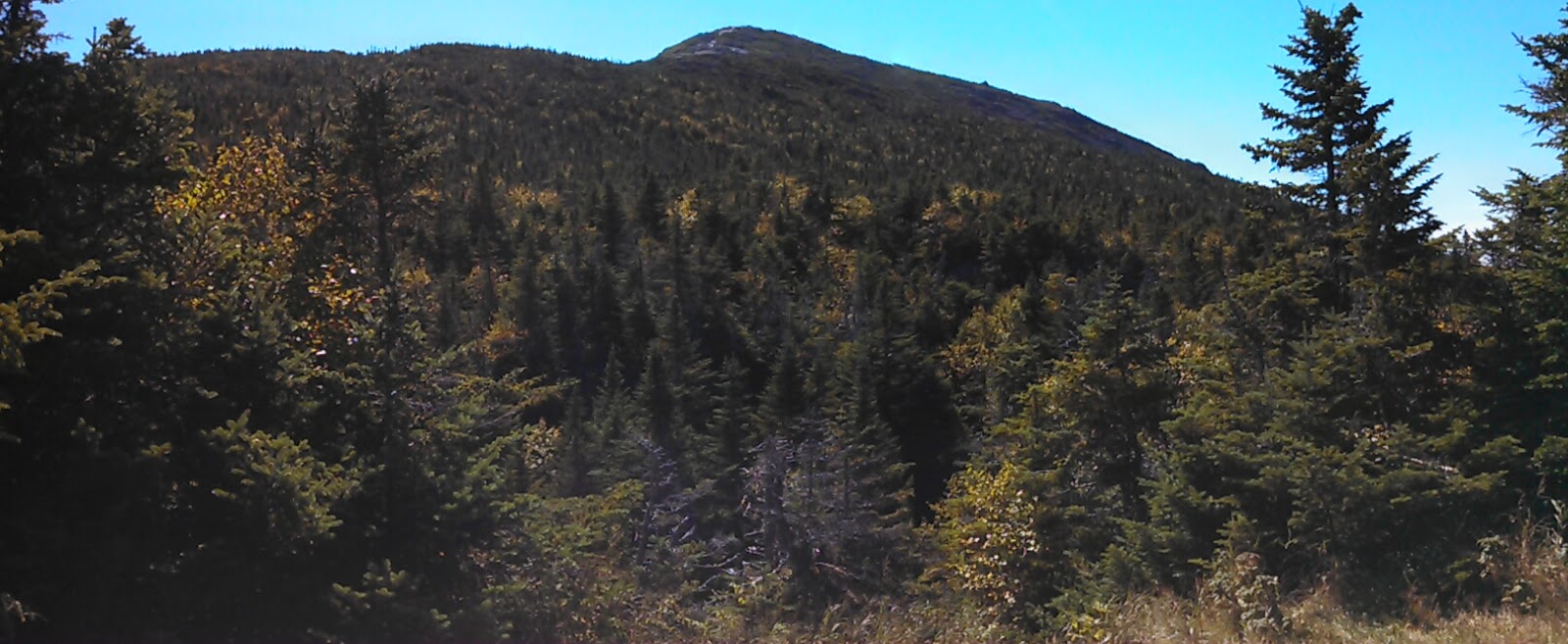
What does one see when one hikes through the woods?  To tell the truth, not much but the forest for the trees.  As we gained in elevation we caught glimpses of surrounding summits through the breaks in the trees.  Tall deciduous yielded to red pines and spruce, which yielded to alpine shrubs and finally to lichen and moss. The one time I looked away from the trail to see the summit of Mt Marcy I tripped over a rock and fell into the alpine bushes.  

Footing was precarious. It is the little rocks that will trick you. Step on one and it may roll twisting your ankle. This happened to me on the way down.  Luckily I recovered quickly throwing my weight off my ankle onto my hiking poles.  

The last bit of climb is over open rock face. Fortunately the weather was perfect. Sunny with little wind, but cool enough to keep ice on the rocks protected from the sun’s warmth. Hard to imagine that these high places were once covered by  glaciers more than a mile thick just a short 10,000 years ago. It was the glaciers that left the Adirondacks a jostle of peaks and gives them their beauty.

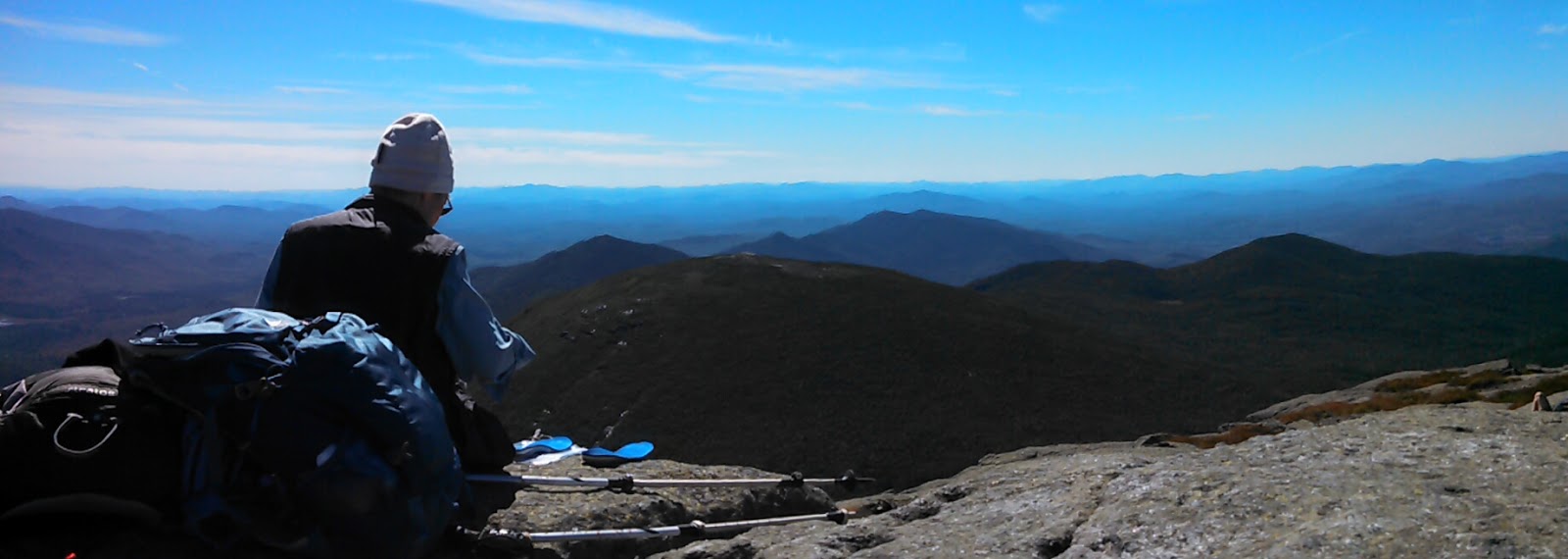
At the summit we sat on the rocks facing southeast, the high sun on our backs.  Unlike Mt. Washington there are no concession stands or warming huts. I broke out a hot drink and two paper cups from the hotel carefully packed so not to be squished. Cheers!  Roast beef sandwiches and peanut butter with honey re-energized us for the return trip that took us the same amount of time we had taken to climb.  Old knees!

 I told  Dad to call the State Troopers if he had not heard from us by 9 pm. We made it back to the car by 6:15, but no cellphone signal was available until we reached Keene at 7 pm.  Robin wanted a cup of coffee and we both expected that the best she would get would be gas station coffee. But we found the perfect place with an espresso machine,  the ADK café. She got a cappuccino and I had a decaf latte.  

As we headed down the Northway there was still a tell-tale sign of daylight on the western horizon.  Another great adventure behind us. I relaxed in my sister’s new Subaru to discover heated seats are a great recovery therapy. I might have to get me one of those.  

Tuesday, September 03, 2013

Day Forty


I expected the morning workout to be light. After all, the horse trailers had been rolling out all night, shipping horses to Belmont, Kentucky and other destinations where thoroughbred racing continues after the six week meet at Saratoga ends. One day of racing remained. One important race, the Hopeful was ahead. 

A hard gale-force wind and an electrical storm kept the training light. Even the early morning Bond Boys wearing red blinking lights on their helmets and safety vests with 007 on the back made a quick exit to the barns when lightening touched too close for comfort.

Between the downpours D. Wayne Lukas crossed Union Avenue to come to the main track. It was the only time I saw him during the 40 day meet. Dressed in a long riding coat and mounted on a large painted pony he came without the typical entourage of thoroughbred owners. Not even an assistant trainer accompanied him.  Alone, he took his horse to the sloppy track emptied of exercise riders by violent rain and wind packed beneath a thunderstorm.  Like a solitary stranger that rode into a one-horse-town on the edge of a prairie, he carried a noticeable presence.  He brought a little hope and a little fear to the town.
But this lone horseman was no cowboy in a  B-western movie. He was a famed trainer. In the midst of thunder and distant lightening a calm air hung around him.  He entered the track and turned toward the far turn, away from the empty grandstand. I wondered what he was doing. Reminiscing? After all, he had certainly sent many great horses to the winner circle. Inspecting the conditions of the soaked surface?  It had rained hard and frequently during the past three days. Saying good-bye? This was the last day of the 150th year of racing at Saratoga.
I will never know what he was thinking, but I suspect he was being one wise trainer. Scouting the track, considering the conditions, figuring it's impact on the race horse.  He had a horse entered in the Hopeful, the race that features the top two-year olds in the country - those that often go on to greatness as three-year olds in big races like the Triple Crown and the Travers. 
When skies cleared and thousands of fans filled the grandstand hours later, his horse, Strong Mandate, became a surprising upset.

The significant event of my last day at the track wasn’t fully appreciated until the following morning when I was sitting at the table eating my breakfast at a normal hour of 7 am. My midnight shifts were over.  Reading the newspaper I learned yesterday was also D. Wayne Lukas’ birthday.  I believe I witnessed a man give himself a birthday present at beautiful and historic Saratoga.

Sunday, August 04, 2013

Making The Transition


Bit by bit. Or perhaps more like hour by hour, I have begun to hit the third shift stride. The first week was tough, when I threw my body’s clock onto graveyard. Although I pretended I was still living in Hawaii it wasn’t an easy transition.  I pushed myself not to doze during the day. My body cried against the new rhythm.  My plan was to be tired enough that I would go to bed at 5 pm and actually fall asleep. That first week, the northeast was perspiring in a heat wave, a six day stretch of ninety plus degrees. I slept in my old room squeezed in a twin bed between two needy cats – one at my feet and the other tucked under my arm pit. In the shade-drawn room the air conditioner droned on cutting out sounds of some mysterious construction project underway in the neighbor’s back yard, and the sound of Dad watching the weather channel’s endless 8 minute cycle.

When the heat broke I moved into the master bedroom. Despite having a larger size bed for my two cats I locked them out of the room. Their curiosity insisted on demanding entrance to the room. My need for undisturbed sleep and their need for access to a liter box ruled otherwise.  There were days that Diablo yowled outside the door and slippers flew through the air out of sheer frustration.

With a project to prep and stain a neighbor’s barn I imposed a curfew. By 3 pm I was to begin to relax and ready my uniform and gear for easy assembly at 11pm. Bedtime was 5 pm.  That kept me up all day after I got off at 8 am. During the remainders of the mornings I pressure washed the barn and then hand washed every rough cut pine board.  By noon my arms had fallen off and my wrists felt like I did a double shift at the Target Distribution Center. And, not to let the summer get by me, I loaded the kayak on the jeep and took off to cruise around Moreau Lake in the early afternoons.

But I had done no hiking since my week in Alaska at the beginning of July. With the plan to hike Mt Marcy after Labor Day I knew I needed to condition my legs for the long 14 mile trek to the summit and  return descent.  Robin and I had talked of doing this last summer and I knew she would be cresting peaks in New Hampshire to get ready. Always more athletic than me, I would have a grueling climb if I didn’t start preparing.

So yesterday I hit the trails above Moreau for the second time this week and got a little disoriented when I forgot my map. I knew I would eventually hit either the lake or the Hudson River, a place I really did not want to end up at.  Three and a half hours later I emerged from the woods on the lake side. By five I was in bed sans cats.

The past two nights have gone by fast. I've been writing and surfing the internet for camping and hiking gear or reading up on the trails in the Adirondacks. During my break I crawl into my sleeping bag laid out in the back of my jeep. I’ve managed to zone out for twenty or thirty minutes, a power nap at 3 am. After 4 am, the gate is wide open to traffic and the next four hours I am on my feet checking IDs, credentials and monitoring horse traffic.

Midway through week three, almost to the half way point of the six-week racing meet at Saratoga, I have got the routine.  I confess I am sleep deprived and I have noticed brain lag. Nothing too serious.  Just a moment of not being able to remember where I put my paint scraper or forgetting what I was going down into the basement to get.   Heck I’ve done that before.  I’ve also fallen asleep under the dryer at the beauty salon.  I did ask my hairdresser is I was drooling.

Friday, July 26, 2013

Nightshift


Early to bed and early to rise makes a man healthy, wealthy and wise. Is there such wisdom for those who watch the sun rise after working the night? 

Across America people wake up to work the nightshift.  It is not the sole domain of the blue collar or unskilled laborer. Professionals prowl the hours between 11 pm to seven in the morning.  Doctors make their residencies in ER, airline pilots trek coast to coast on the red eyes.  International business people speak to call centers a dozen time zones away.   IT geeks tweak code; the independent writers type out 500 word articles; DJs on local and national air waves stir tired imaginations with spooky ramblings of international espionages, government conspiracies, UFO kidnappings, the miracle of vitamin power and  the spoils of  Franken foods. With them are the traditional over night workers – the factory employees make, shape and build America.  The nocturnal long-haul truck driver rolls down the center line,  the janitor swabs bathrooms and restocks the paper towels, the garbage collector clangs metal cans at the street-side curb,  the cab driver delivers passengers and the security guard patrols long hallways, and the dark stairways of warehouses, sky scrappers, office buildings, schools, wharfs and barns. (Some barns have hallways and stairways.)

There is a whole industry of night beyond the making of donuts and the printing of newspapers. It is of shipping and hauling product and produce, of unpacking and stocking merchandise, of staging and positioning packages for morning deliveries.  These activities ready the economy for the upcoming day.  Nights make days and it is done by an estimated three million Americans.
   
I’ve never worked a graveyard shift.  I was in sweet dreamland long before the moon rose and red traffic signals glared across the cityscapes with angry fiery eyes like the devil himself.  No one should see creepy shadows run across open fields or lurk at the edges of forest. No one should have to venture into poorly lit alleys or cross a street in the echoes of their own foot steps.  After all, we know the story of Ichabod Crane.  

As a teen I rose early. This might have had something to do with my mom whose trigger finger on a light switch was faster than a bolt of lightening on a golf course. It didn’t matter if it was a 6 am on a school day or a weekend. When the slim thread of light stitched its pattern across the horizon to reveal the green mountains of Vermont it was time to rise and shine. Time to up and at’em. Time to make hay. And at the other end of the day I got between the sheets early too. Even in the summer before the sun sank below the crown of pine on the hill I “hit the hay”.  To go to bed with the chickens.  And chickens never worked the nightshift.

I love the morning. Full of promise.  Long sun rays enrich the landscapes with golden tones first caught on hill tops, then tree crowns and finally open fields. The sounds of crickets and katydids fall silent to the birds’ song that seems to coax the sun into splendor..  In the dips and valleys cooler air settles as if it slept the night away.  There is an anticipation of the morning lingering in the faded shadows of night. Mornings are fresh starts.  They are daily do-overs.

Now I am on nightshift and lost.  My mind and body are confused. It is like having the “sleeping” me on Hawaii Time, but the “waking” me on Eastern.  I wake at ten pm feeling the night, so aware that what is ahead are more hours of darkness.  The crickets’ chirps sound like “sucker, sucker.”  The moths dance in the yellow hues of tungsten. Watching their futile flutter exhausts me. Kamikaze June bugs dive bomb into the side of the guard shack.   The whispered rustling of invisible trees is unsettling.  I feel the burden of summer humidity sink in the low lands – damp and chilled.  There are faint odors of disturbed circumstances: a distant thunderstorm, a nest of skunk, the musky smell of horse and tilled earth on a silent track.

This is where I chose to be.  I traded the fevered excitement of the crowds gathered in the grandstands clutching winning hopes on horses that breezed easily in the soft blue light of dawn two days ago.  Requests to know the whereabouts of the nearest bathroom or ATM have been replaced with friendly “good mornings” exchanged with grooms and exercise riders or semi-polite nods from trainers and owners who flash ID cards with slight annoyance.  The post parade has become a frenzied coordination of horses, bicycles, golf carts, cars, vans and trucks across a busy street.  

And four days on the nightshift and I have not smelled one cheap cigar.  Just one more thing I don’t miss about working days at the Saratoga Race Course.  Wise move.

Wednesday, July 10, 2013

Whittier


Am I already forgetting? Did I hike the Crow Creek Trail on the same day we also went to Whittier? July 3rd? What a packed day in Alaska!  So let’s recap a bit here, including some photos for those of you who manage to stay off my FaceBook. And new ones for those who are on FaceBook.

I’ve been to Whittier three times before this trip.Twice by train and once by sea. Back in the day the only other way to arrive would have been to fly.  Since 2000, Whittier has been connected to the world by car when the 2.5 mile long train tunnel was resurfaced to accommodate vehicular traffic. The tunnel is a straight shot through the massive mountain that confines Whittier to a narrow seaside strip of land on the west side of the Prince William Sound. This makes the tunnel the longest car-rail tunnel in the US.

Finally someone got the brilliant idea to let cars drive through the tunnel and so autos, buses, campers and even tractor-trailers alternate between westbound and eastbound flows every half hour except when a train is scheduled. Then the traffic cues at the entrances to wait out the train and the clearing of smoke in the tunnel. Easier access makes Whittier a hot spot for tourists who wish to see a town where the entire population lives in one large ex-military bunker that once was the largest building in Alaska. (1940 time frame) I know, weird.  It’s a big building. 

Where everyone lives. One floor use to have a bowling alley. 

  There is a long pedestrian tunnel underneath the train yard that connects the residents with "downtown."  Because everyone lives in one high rise structure few roads need to be plowed in the winter.  Good thing.  Winter doesn't forget Whittier and in the summer it gets over 120 inches of rain.

So, it was rainy when I showed up 39 years after I first came here when I took my scuba certification dive in mid-January. It was 18 degrees on that day. The water was warmer than the air.  The best time to dive in Alaska is January.  Little glacier runoff to muddy the waters.
 
The third time I came to Whittier I rode my bike from Glennallen to Valdez.  Then I jumped a ferry to Whittier where I caught the train back to Alaska. That trip was awesome. 

I am still struck by the uniqueness of the little port that hosts some of the finest halibut fishing. I never expected to return there on this trip but when my friend, Mike, told me the tunnel was open to cars, and he had never been there…well, I couldn’t pass on the opportunity to get there.   

We kicked around “town” because if you are not taking a cruise or going fishing there isn’t a whole lot to do. You can rent a kayak and have an ice cream cone, but it was 52 degrees and raining. That had hypothermia written all over it.

On the way back to Anchorage we stopped in Girdwood and drove up to the Crow Creek Trail head.  It was about 3 pm and I never hit the trail in late afternoon. But the sun wasn't setting until almost never, and this hike was the only thing I wanted to do while visiting Alaska.  Thirty-five years ago, on July 4th I had hiked this very same trail with Mike and his buddy Dan. We hiked on snow.  I wanted to duplicate the hike. I thought hiking in snow in July was just as unique as, well... Whittier. Mike and I duplicated the hike, minus Dan, but we remembered him.

Since Alaska had been experiencing 80 to 100 degree temperatures prior to my arrival, there wasn’t much snow on the trail. We made it to the old abandoned mine, a good climb. Since Mike and I are both photographers it was easy to have the excuse to stop and catch our breaths while snapping the incredible vistas.  Actually, I am in better shape now than I was then. So the trail wasn’t hard. I got my feet into snow. This is all I will say about that.  
 
No bear sightings. However here’s a link to an article posted five days after my hike.

By Chris Klint
Channel 2 News

July 8 2013, 4:58 PM AKDT

ANCHORAGE, Alaska -- Chugach State Park rangers have closed three miles of a trail within the park, after reports of a hiker being charged by a brown bear and a possible moose carcass seen in the area after the weekend incident.

The complete article can be viewed at:
http://www.ktuu.com/news/chugach-state-park-trail-closed-after-bear-charging-incident-070813,0,2129152.story

PS: If you go to Whittier on foot or on bike, you still have to catch a ride or jump the train. 


Saturday, July 06, 2013

Like the Mountains


Arrival 5:45 am. After a six hour flight from Honolulu I was back in Alaska after a 35 year absence. Back then I had spent the summer working at Castleton’s Photo Lab. It was a transitional time, the summer when I moved from the back waters of Louisiana to the booming town of Atlanta. I stayed with a friend who also had been in the Army and worked in the same photo lab. 

Even before I got off the plane and walked through the Ted Stevens International Airport I recognized the changes that had occurred in the past years. From the plane’s window on the approach to Anchorage I saw Earthquake Park - full of trees. No longer was the angulated ground caused by the devastating 1964 quake visible for the thick green canopy hid the once broken earth. Afterall, It had only been nine years since that damage occurred.  In the distance I recognized a few building in the Anchorage skyline. Only the Chugach Mountains resting on the eastern horizon seemed unchanged.

This had been the place I grew up. Not in the sense of new born to adulthood. But here I had my first experiences away from home. At eighteen I had joined the Army. Spring of 1973, the end of Viet Nam. After completing basic training and my Advanced Individual Training (AIT) as a Photo Lab Tech my orders came down for Alaska. I was a bit bummed about this for most of my new Army friends were headed to Germany and they ribbed me about my assignment. “Dog sleds and mukluks are standard issue.”   

In the wee hours of the morning I boarded a bus at Ft Lewis to catch a military transport to Ft Richardson/Elmendorf.  I stared beyond my reflection out the window into the darkness at silhouettes of barracks and other undistinguished government buildings on base.  Home sickness overwhelmed me. The most lonely, isolated feeling struck my gut.  I longed for something familiar. I wanted to cry. I wanted to go home.  There was nothing adventurous about this trip. The next two and a half years of my life lay ahead of me. The rest of my life was beginning and I saw nothing but the reflection of a young soldier who was headed north to Alaska all alone.

When the plane landed the pilot announced it was fifteen degrees outside. I thought he said fifty.  I wouldn’t feel that until next summer. One of 30 women on base I was soon making friends and having a good time doing stupid things, things that are curiously all part of growing up. When I left the Army and Alaska, I was married, headed off to college and happy. That Alaska experience wasn’t so bad after all.  

Now I was back. My Army buddy, Mike was still here and so were 200,000 more people added to the town that was approximately 150,000 in the seventies. Dirt roads were now paved. The Glen Highway had additional lanes. The boonies now covered with strip malls. Here was Target, WalMart, Olive Garden and Bed, Bath and Beyond. We crossed North Lights Boulevard. Tudor Ave. C Ave. Nothing was familiar but the names. The bars and strip joints on 4th Ave were gone.  Some things do change for the better.

As Mike took me around the city I had a faint feeling of a dream. I remembered bits and pieces of that dream, but nothing coherently ran together. It was as jumbled as the city after the ’64 quake.  I was sure I had done this before, been here once upon a time, but everything was different. Like hearing a movie score but not being able to recall the movie. Like smelling a certain fragrance, but not recalling from where. Like tasting a spice but not being able to identify it.  I knew this place and yet I knew little about it.

Except one thing.  I came down the airport concourse and immediately saw Mike, a friend who had kept in touch when keeping in touch was not as easy as a FaceBook post, a Google search, Twitter account or hitting send on an email. A friendship that lasted pretty much unchanged, picked right back up much like it was when we met for the first time in October 1973, forty years ago. Some things change. We might have more wrinkles, less hair, grayer hair, more weight and a few aches and pains of age, but the best things don’t change.  They last like the mountains.

Wednesday, June 12, 2013

Two If By Sea


After missing my guide on Friday night I headed back to the cabin in Volcano Village. My cell phone rang. It was an unfamiliar number, but I answered it anyway.  It was Shane the boat captain of LavaKai and the owner of Lava Ocean Tours, Inc, the company for which my “missing” tour guide worked.  Shane apologized and explained what had happened.  Shane had been out on the boat and unable to call when the company’s reservationist tried to find out why my guide was a no-show.  He offered to make arrangements for another hike but of course I had already done so.  He invited me to take a boat tour, compliments of him. I told him I was already signed up. All the better he said. And it would be at no charge.  I thanked him for his call and looked forward to meeting him on Sunday morning. He assured me if I didn’t eat much Saturday night, stayed away from coffee in the morning and sat in the back of the boat I wouldn’t get sick.  Yeah, yeah, yeah. Been there and done that. I get sea-sick in elevators.

On Saturday, after I managed to find my way out of Ed’s community it took an hour to get back to Volcano Village. It was around 10 pm.  I was tired. My feet hurt. I knew my legs would be sore from walking on the uneven lava surface.  A hot shower helped, but the unheated bathroom left me quickly climbing back into my sweatshirt and socks.  Before turning in I downloaded the photos and recharged the camera and phone batteries. The alarm was set for 2:15 am.  Sleep didn’t come easily despite my weariness. Every half hour I found the clock staring at me. I gave up at 2 am, gathered my gear and headed out into the mist and drizzle. 

Early on Saturday I donned those pressure point wrist bands that supposedly prevent seasickness. After I arrived at the launch site I popped one Dramamine. If I took two I would surely fall asleep.  In my backpack was plenty of water, and a bandana to wipe the puke out of my nose and off my face.  I checked to be sure had the wintermint gum to rid the bitter tasting bile from my mouth. I am a puking pro. The dread of sea sickness doesn’t stop me from going to sea, but by sitting in the car and waiting I psyched myself into a little queasy.  I got out and walked around the empty parking lot.

It was 65 degrees and a light mist fell as Shane went over the realities of the boat ride. “Not your dinner cruise. It will be rough and you will get wet. If you have any back problems, heart problems, respiratory issues, this is not your trip. Be honest with yourself. Pre-existing conditions will not be covered by my insurance. Remember you are on vacation. You don’t want to end up in the hospital.  If you want the smoothest ride, move to the back of the boat. Does everyone speak English?”  We nodded. “Good. Then I will assume everyone just understood what I said.”  If anyone had second thoughts nobody spoke up. We stood silently in the rain under the eerie yellow glow of lamppole #4.

We boarded the LavaKai by climbing a ten foot ladder while it sat on a trailer in the parking lot. I put on another layer under my rain gear and followed a couple of professors for the University of Wisconsin to the stern.   The boat was then taken to the launch and turned loose in the harbor. Shane turned the craft on a dime and we headed out to sea.  I glued my eyes to the dark ridge that hung on the western horizon. The boat cut quickly through the three foot sea swells flinging a sometimes heavy spray into the boat.  Periodically a dim pin point of light emerged from the shore line and disappeared.  Not too many people lived along this remote coast.

High above the lava plain sits the source of all the current flows Puu Oo.  The cinder cone’s glow hovered in a void of black. January marked the 30th anniversary of Kilauea’s ongoing eruption from Puu Oo.  Due to its remoteness inside the Volcanoes National Park most visitors never see it. Until now, I had never seen it. Those who hike the trail to the cinder cone are warned not to come closer than a mile. At the forest edge near Puu Oo all the vegetation is dead from toxic fumes.
 On the fast moving LavaKai, we soon approached the red glows from the ocean entries. The captain kept the boat moving by maneuvering the craft just outside the shore break.  The water is over a couple hundred feet deep here so waves break within a few feet of the fresh lava.  The crashing roar of waves on the advancing lava and stirred winds from its rapid cool wrapped the boat in a surreal environment. The boat’s engine’s growled in the churning surf fighting the draw of the sea to the rocks. Noxious sulfur swirled around us and invaded my lungs.

The crew tossed a bucket into the water and drew up the sea water so we could feel its temperature. I only dipped a finger in it as I didn’t want the sticky salt all over my hands as I operated my cameras.  It felt Jacuzzi hot.

The brightness of the lava ripped the night apart.  Frustrated by the cameras’ attempt to read the lava’s light, the bright glow reflected in the steam clouds and the stark darkness I had trouble setting a good exposure.  The sea’s motion made shots blurry. But I kept experimenting and wondered how everyone else managed to just shoot the scene. As day broke I got cleaner shots. 

I stopped myself to just look. To simply sit on the deck and view the awesome struggle of endless creation and destruction. Globs of molten lava spurted forth from behind a curtain of pink clouds that shrouded where it emerged from deep inside the earth.  Waves crashed ashore, ripping the red flow from the shelf and sweeping it unto the sea.  Burning rocks floated near the boat. In the raging surf the lava dramatically cooled, hissing in painful protest.  Vapors swept off the coast and danced across the black waters where reflected light patterns shattered beneath the lava’s demonic glare. Neither sea nor volcano ceased in its efforts to dominate the other.

I finally had seen lava flowing. New earth created and destroyed at the same time. Acres upon acres of new land have been created by Kilauea in the last thirty years, yet everyday the sea steals acres of the new creation.  The captain made one last pass at the lava before turning toward dawn and then back to Hale Isaac Beach. 

I never even thought about feeling sick.